Bron: https://nos.nl/artikel/2473495-appartementen-en-monumenten-hoeven-niet-aan-de-warmtepomp
Apartments and historic buildings are not required to install heat pumps
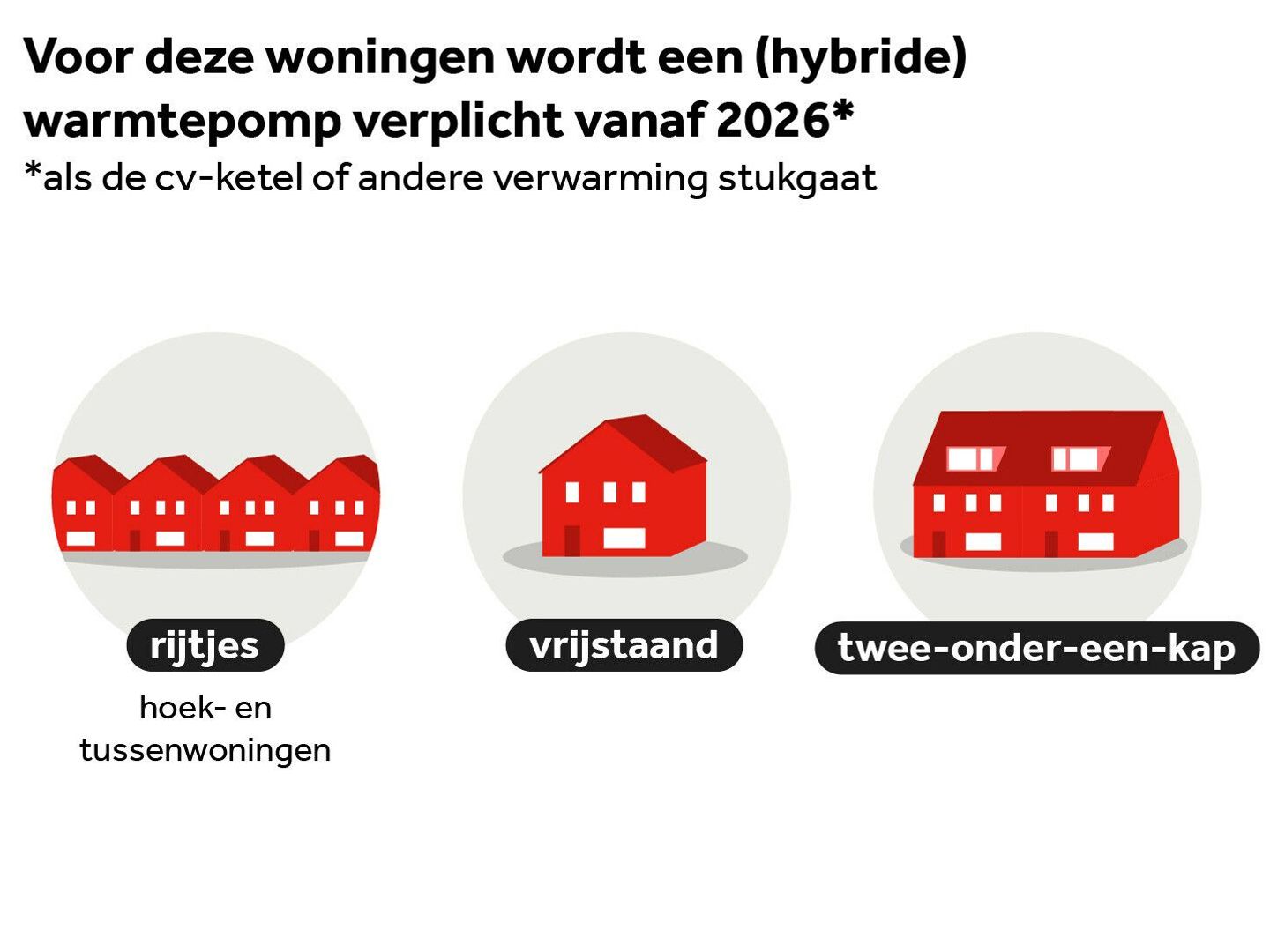
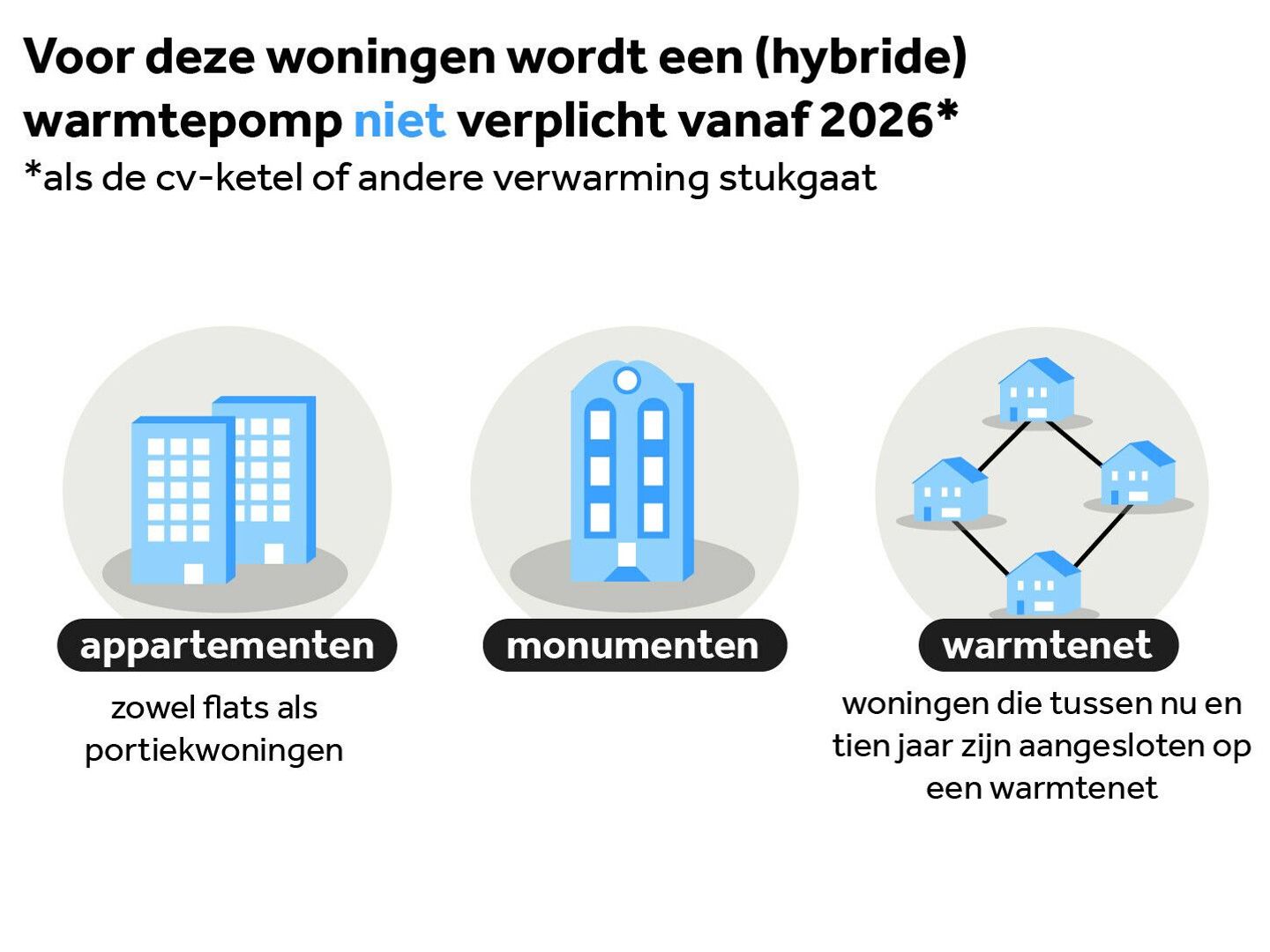
Starting in 2026, owners of single-family homes, semi-detached homes, and townhouses will be required to install a heat pump when their boiler needs to be replaced. This requirement does not apply to owners of apartments, historic buildings, or homes that will be connected to a district heating network in the coming years.
Minister De Jonge of Housing announced this in a letter to Parliament. He wants to provide clarity to both homeowners and the plumbing industry, as the regulation will take effect in just three years.
De Jonge believes it is important that the payback period remains under seven years—the same timeframe used when purchasing solar panels. Previous research shows that people find this acceptable for such an investment. And the higher energy prices are, the shorter the payback period.
Homeowners, institutions, and small businesses can take advantage of subsidy programs that cover 30 percent of the average investment costs. According to calculations, most homes in the Netherlands can recoup the cost of a heat pump within ten years. With that 30 percent investment assistance, the ten-year payback period should be reduced to the desired seven years. A total of 900 million euros has been set aside for this purpose through 2030.
Financial assistance for low-income individuals
Homes where the payback period exceeds ten years—for example, if extensive renovations are required to install a heat pump—are exempt from the requirement. Low-income households can also apply to the National Heat Fund (NWF), where they can obtain a 0% interest loan.
Natuur & Milieu welcomes the plans but is critical of the costs for people on low incomes. That is why the environmental organization is calling for an additional subsidy. They note that the interest-free NWF loans are still difficult to find and that people are reluctant to take out loans. “Favorable financing terms are desperately needed.”
Depends on the landlord
Tenants cannot install a heat pump on their own. Apartments are already exempt from the requirement anyway, as there isn’t enough space for the units, which are often large and noisy.
For so-called ground-level homes—such as row houses or semi-detached homes—the responsibility lies with the owner, i.e., the landlord. After installing a heat pump, landlords are permitted to raise the rent due to the home improvement and the lower energy bills. This allows them to recoup the investment.
Historic buildings are also exempt, as they require specific permits for home renovations.
How does a (hybrid) heat pump work?
A heat pump uses heat from the air, ground, or groundwater and uses electricity to increase its temperature. No gas is required. A heat pump consists of an indoor unit and an outdoor unit, so it requires quite a bit of space. Some types are also quite noisy.
Because a heat pump provides heat continuously and responds somewhat more slowly when water needs to be heated quickly (for example, for showering), some people opt for a hybrid heat pump. When rapid heating is needed, the central heating component of a hybrid heat pump kicks in, and that runs on gas.
So they aren’t natural gas-free, but they are 60 percent more energy-efficient than central heating boilers. Hybrid heat pumps are seen as a stopgap solution, because the government wants the Netherlands to be natural gas-free in the future.
In existing buildings, the (more affordable) hybrid heat pump is usually chosen, while in new construction—which is already gas-free—the fully electric model is preferred.
Last year, Katja Kruit of the environmental research firm CE Delft conducted a study to determine the feasibility of heat pumps for Dutch homes. Her findings are largely in line with De Jonge’s plans.
“This gives people a clear idea of what to expect, although I still have some questions about the details. For example, what about noise standards? There is still a lot of uncertainty about how much noise heat pumps make and how strictly the requirements are monitored and enforced. You hear that, in practice, heat pumps make more noise than was originally calculated.”
She also notes that it is not yet entirely clear whether people will have to calculate the payback period themselves, or how complex those calculations will be. Previous research by CE Delft showed that certain smaller row houses, such as courtyard homes, have a payback period of more than ten years. Furthermore, space constraints are an issue in these homes. These homes are now subject to the requirement.
“For most homes, a hybrid heat pump is a very cost-effective solution, but in some cases, the details still need to be worked out.”
'Go all out'
The HVAC industry is already preparing for 2026, and Brancheclub Techniek Nederland believes this goal is achievable. Chairman Doekle Terpstra says, “We are doing everything we can to train enough heat pump technicians. Manufacturers are investing in a significant expansion; for example, three additional production sites will soon be opening in the Netherlands.”
According to the association, 42,000 heat pumps for residential use were sold in the first quarter of this year. Last year, 22,000 were sold during the same quarter.
The following homes are (not) subject to the requirement: